

Description
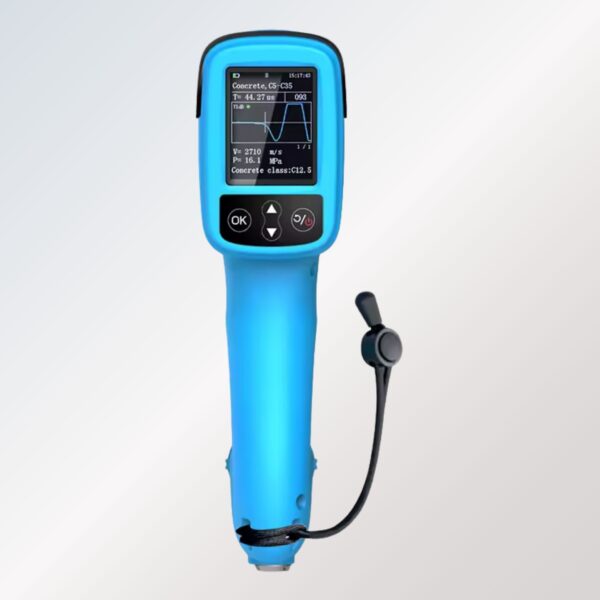
Ultrasonic Pulse Velocity Tester is a high-precision non-destructive testing (NDT) instrument used to evaluate the quality, uniformity, and integrity of concrete and other construction materials. By transmitting ultrasonic pulses through the concrete and measuring the travel time between transducers, the instrument determines the pulse velocity, which helps assess concrete quality, detect internal defects, estimate crack depth, and identify voids or honeycombing.
Designed for both laboratory and field applications, the UPV Tester delivers fast, accurate, and repeatable results without damaging the structure. It is widely used for quality control, structural condition assessment, bridge inspections, tunnels, dams, precast elements, and infrastructure projects.
Key Features
- Non-destructive evaluation of concrete quality
- High-accuracy ultrasonic pulse measurement
- Digital LCD display with real-time readings
- Suitable for direct, semi-direct, and indirect testing
- Detects cracks, voids, honeycombing, and internal defects
- Built-in memory for data storage
- USB/Bluetooth data transfer (model dependent)
- Automatic pulse velocity calculation
- Portable, lightweight, and rugged design
- Rechargeable battery for extended field use
Applications
- Concrete Quality Assessment
- Bridge and Flyover Inspection
- Building Structural Evaluation
- Dams and Hydroelectric Projects
- Tunnel and Underground Structures
- Precast Concrete Manufacturing
- Pavement and Highway Projects
- Civil Engineering Laboratories
- Infrastructure Maintenance and Inspection
Technical Specifications
| Parameter | Specification |
|---|---|
| Test Method | Ultrasonic Pulse Velocity (UPV) |
| Measurement Range | 0.1 – 9999 µs |
| Pulse Velocity Range | Up to 15,000 m/s |
| Display | Digital LCD |
| Transducer Frequency | 24 kHz / 54 kHz (Model Dependent) |
| Data Storage | Internal Memory |
| Communication | USB / Bluetooth (Optional) |
| Power Supply | Rechargeable Lithium Battery |
| Standards | ASTM C597, EN 12504-4, IS 13311 (Part 1) |
Benefits
- Evaluates concrete quality without damaging the structure
- Detects internal cracks, voids, and honeycombing
- Assesses concrete uniformity and homogeneity
- Supports preventive maintenance and structural safety
- Provides fast, reliable, and repeatable test results
- Reduces inspection time and testing costs
- Improves quality control for construction projects



Reviews
There are no reviews yet.